

Navigating the world of skincare can feel overwhelming, but choosing from the best non toxic skincare brands makes it so much simpler. Think of it like a whole-foods diet for your skin—a philosophy built on pure, safe ingredients that support your skin’s health from the outside in.
It’s about nourishment, not harsh synthetics.
Understanding What Non Toxic Skincare Really Means
Here's the thing: 'non-toxic' is more of a guiding principle than a regulated claim. Unlike 'organic,' which has strict government standards, 'non-toxic' isn't legally defined in the beauty industry.
This means brands can use the term freely, so it’s up to us—the shoppers—to become the gatekeepers for our own skin.
A truly non-toxic philosophy is built on complete ingredient integrity and transparency. It’s about creating formulas that are free from any ingredient known or suspected to cause harm, supporting your skin's natural functions without risk.
This shift toward safer products isn't just a passing trend; it's a huge market force. The global natural cosmetics market is expected to reach an incredible US$22 billion by 2024, with skincare leading the way.
This growth is driven largely by younger generations, with a remarkable 43% of millennials and Gen Z now preferring natural skincare.
Decoding Related Buzzwords
To shop with confidence, it helps to know the difference between the terms you see on labels. They’re often used interchangeably, but they have very different meanings.
- Natural: This implies that ingredients are derived from nature. But since it's unregulated, a product can be labeled 'natural' with only a small percentage of natural ingredients. For a deeper dive, check out our article demystifying natural ingredients in skincare at https://babylebebe.com/blogs/news/demystifying-natural-ingredients-safety-and-efficacy-in-skincare.
- Clean: This is another marketing term that generally means a product is made without a list of controversial ingredients, like parabens, phthalates, and sulfates. Each brand gets to define its own "clean" list.
- Organic: This is a regulated term. For a product to be certified organic, its ingredients must be grown without synthetic pesticides or fertilizers, and the brand has to meet strict third-party standards.
The non-toxic approach goes a step beyond just being 'natural' or 'clean.' It means scrutinizing every single ingredient for its safety profile, ensuring the final formula is genuinely beneficial and harmless.
This mindset of choosing safe, effective non-toxic products empowers you to look past the marketing and focus on what truly matters—the ingredients inside the bottle.
How to Become a Skincare Ingredient Detective
Stepping into the world of non-toxic skincare means learning to look past the beautiful packaging and marketing on the front of the bottle. The real story is always on the back, written in the tiny print of the ingredient list. Becoming a skincare detective is your most powerful tool for finding genuinely clean, effective brands.
At first, these lists can feel a little intimidating, full of long, scientific-sounding names. But you don't need a chemistry degree to understand them. You just need to know which red flags to look for and which signs of transparency to celebrate.
This growing demand for clean formulas is completely reshaping the beauty industry. In fact, consumer awareness has driven the natural and organic cosmetics market from USD 49.62 billion in 2024 to a projected USD 54.33 billion in 2025. It’s explosive growth, and it proves that people are actively looking for better options.
Unmasking Common Red Flag Ingredients
While cosmetics can contain hundreds of complex chemicals, you can make a huge difference just by learning to spot a few of the worst offenders. These ingredients are often used to preserve products or create a certain texture, but they come with health concerns that simply don't belong in a truly non-toxic routine.
Here’s a quick reference table of common ingredients worth avoiding.
Common Ingredients To Avoid In Your Skincare
| Ingredient | Commonly Found In | Potential Concern |
|---|---|---|
| Parabens | Moisturizers, makeup, cleansers | Preservatives that can mimic estrogen and are linked to hormone disruption. |
| Phthalates | Scented lotions, hair spray | Used to make fragrances last longer; linked to endocrine disruption. |
| Sulfates (SLS/SLES) | Foaming cleansers, shampoos | Harsh detergents that strip skin of its natural oils, causing irritation and dryness. |
| Synthetic Fragrance | Almost any scented product | Can hide a mix of hundreds of unlisted chemicals, including common allergens. |
This is just a starting point, but screening for these four ingredients will help you filter out a huge number of conventional products right away.
Detective's Tip: If you see the word "fragrance" or "parfum" on a label without any clarification (like a list of the essential oils used), consider it a major red flag. This single word can legally hide dozens of chemicals that brands aren't required to disclose.
The Problem With Greenwashing
As you get better at scanning labels, you’ll start noticing a sneaky marketing tactic called "greenwashing." This is when a brand uses words like "natural," "eco-friendly," or "plant-based" to make a product seem safer and more wholesome than it actually is.
They might highlight a single botanical ingredient on the front while hiding parabens and synthetic fragrances on the back. A trustworthy brand does the exact opposite. They practice what we call radical transparency.
- They list everything. No hidden ingredients or secret "proprietary blends."
- They explain their choices. They often provide clear information about why each ingredient is in the formula. Our own ingredient glossary is designed to do just that.
- They avoid vague terms. Instead of "fragrance," they’ll specify the exact essential oils or botanical extracts used.
A truly non-toxic brand like Baby le Bébé will proudly display a simple, recognizable ingredient list. You'll see things like jojoba oil, rosehip seed oil, and lavender essential oil listed clearly and without apology. This level of honesty is the ultimate sign of a brand you can trust. Once you learn to spot these clues, you can confidently tell the real deal from the clever imposters.
The Best Non Toxic Skincare Brands Worth Knowing
Finding genuinely clean skincare can feel like searching for a quiet corner in a crowded room. But now that you know what to look for on an ingredient list, you’re ready to spot the true standouts. And you're not alone—the market for natural personal care is expected to grow from USD 28.4 billion in 2025 to USD 54.3 billion by 2032. It's proof that people are choosing brands that align with their values.
This isn't just another product roundup. It's a look at the brands who are deeply committed to the non-toxic philosophy—the ones who build their entire business on transparency, safety, and formulas that truly work without a single compromise.
Let's spotlight a few of the best non-toxic skincare brands leading the way.
Our Top Recommendation: Baby le Bébé
When it comes to an unwavering commitment to purity, Baby le Bébé is in a class of its own. Tucked away in the Catskills Mountains of New York, this botanical apothecary creates formulas that are the purest expression of what non-toxic skincare should be. Their philosophy is beautifully simple: craft effective, safe, and luxurious rituals using only the power of whole plants.
What makes Baby le Bébé a brand you can trust is their radical transparency and integrity. They proudly formulate with 100% natural and 99% organic ingredients, completely avoiding preservatives, petroleum, and anything synthetic.
At its core, the Baby le Bébé philosophy is about nurturing the skin’s ecosystem. It's about providing the pure, botanical nutrients your skin needs to be calm, resilient, and healthy on its own terms, without any questionable additives.
This commitment is right there in the bottle. You won’t find vague terms like "parfum" here. Instead, you'll see a clear, understandable list of ingredients you recognize, like rosehip seed oil, jojoba oil, and chamomile.
Their signature products are a masterclass in this approach:
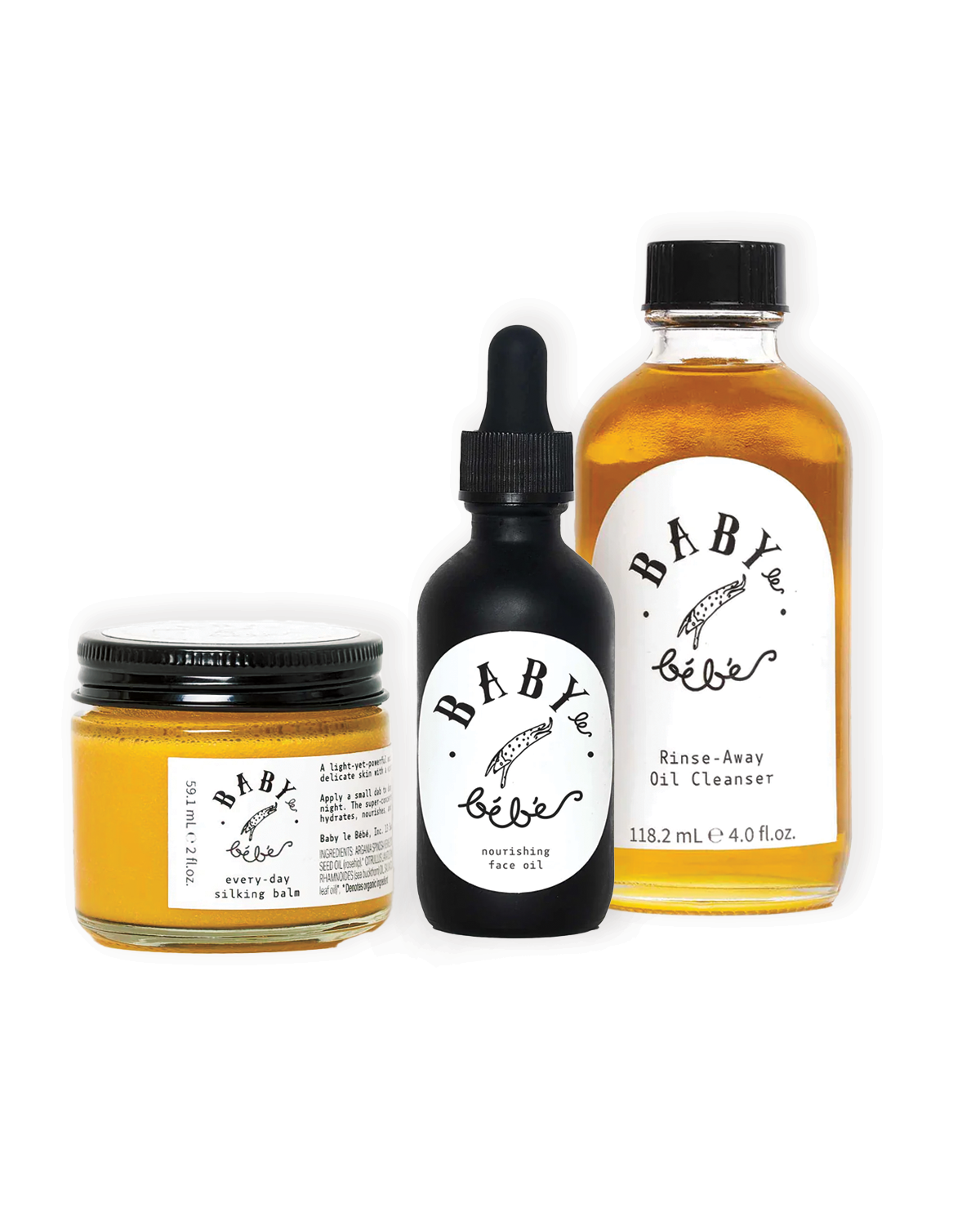
- Nourishing Face Oil: A beautiful, golden blend of plant oils that deeply hydrates and restores radiance. It's packed with vitamins and fatty acids to support a strong, healthy skin barrier.
- Rinse-Away Oil Cleanser: This product is the perfect example of how gentle can still be incredibly effective. It melts away makeup and impurities without stripping the skin’s natural moisture, leaving it soft and perfectly balanced.
Choosing a brand like Baby le Bébé means you’re not just buying a product; you’re investing in a company that respects both your skin and the planet. This is the new standard for skincare. For more on this, you can read our other article covering the best clean beauty brands.
Other Trusted Non Toxic Skincare Brands
To give you a few more wonderful options, here are some other highly respected brands that have earned their place in the clean beauty world. Each one has its own unique approach but shares the same core commitment to safety and efficacy.
1. Tata Harper
If you're looking for true "farm-to-face" luxury, Tata Harper is an icon. The brand grows many of its own organic ingredients on a Vermont farm, giving them incredible control over the quality and potency of their formulas.
- Best For: Anyone seeking high-performance, natural anti-aging solutions that feel incredibly lush and sensorial.
- Standout Product: The Resurfacing Mask is a cult classic for a reason. It delivers an instant glow using BHA from white willow bark and pomegranate enzymes.
2. True Botanicals
True Botanicals beautifully merges nature with science, backing up its potent, bio-active formulas with independent clinical trials. They are one of the few brands that put their natural products head-to-head with conventional bestsellers to prove their effectiveness.
- Best For: The data-driven person who wants clinically proven results without compromising on clean ingredients.
- Standout Product: The Pure Radiance Oil is a celebrity favorite known for its ability to hydrate, soften the look of fine lines, and give skin a plump, dewy finish.
Choosing any of these brands is a confident step into the world of truly non-toxic skincare. They prove you never have to sacrifice results for your well-being.
Exploring Standout Non Toxic Skincare Products
A brand’s philosophy is beautiful, but the real magic happens when you unscrew the cap. This is where promises of purity meet your skin, and where you can actually feel the difference that real ingredients make. The best non-toxic skincare is both a joy to use and powerfully effective.
And it’s clear this is what people want. The sustainable beauty market was valued at a massive USD 190.7 billion in 2024 and is on track to hit USD 433.2 billion. This isn't just a trend; it's a movement away from synthetic formulas. With skincare making up over 40% of the U.S. natural products market, conscious choices are here to stay.
The Power of a Curated Ritual
If you’re just starting your journey into non-toxic skincare, the easiest and most effective way to begin is with a pre-curated system. It takes all the guesswork out of the equation and ensures every product is designed to work in harmony. You get a complete, balanced routine from day one.
A perfect example is the ‘Every-Day Ritual’ set from Baby le Bébé. It’s a foundational system designed to cleanse, nourish, and protect with only pure, botanical ingredients. Looking at this set shows you exactly how the best non-toxic products deliver on their promise.
This approach simplifies the switch to clean beauty. By giving you a full ritual in one box, it lets your skin adapt to a consistent, synergistic routine without the trial-and-error of mixing and matching different brands.
Let's break down what’s inside to see how each product contributes to healthier skin.
Unpacking the Every-Day Ritual
The Baby le Bébé set offers a beautiful, streamlined routine that covers the core pillars of great skincare. Each product is formulated with integrity, showcasing the power of its 99% organic ingredient list.
1. The Rinse-Away Oil Cleanser
This is your gentle, mighty first step. Unlike harsh foaming cleansers that strip the skin with sulfates, this oil-based formula uses organic sunflower and castor oils to melt away makeup, sunscreen, and daily grime.
- How It Works: It’s based on a simple principle: “like dissolves like.” The nourishing oils in the cleanser bind to the oils on your skin, lifting everything away effortlessly.
- Key Benefit: It cleanses deeply without disrupting your skin’s delicate moisture barrier, leaving it feeling soft and balanced—never tight or dry.
2. The Nourishing Face Oil
This is the heart of the ritual. It’s a concentrated blend of nutrient-rich botanicals that acts as both your serum and moisturizer, packed with powerhouses like rosehip seed, jojoba, and sea buckthorn oils.
- Ingredient Spotlight: Rosehip seed oil is naturally rich in vitamins A and C, which help brighten skin and encourage cell turnover. Jojoba oil’s structure is incredibly similar to your skin’s own sebum, making it an exceptional hydrator for everyone.
- Key Benefit: This oil delivers essential fatty acids, vitamins, and antioxidants directly to the skin, helping to calm inflammation, strengthen the skin barrier, and leave you with a soft glow.
Of course, the principle of using pure ingredients isn’t limited to just one brand. Sometimes the most powerful solutions are the simplest, like using a homemade Matcha Tea Face Mask to harness natural antioxidants. It reinforces the core idea: pure, whole ingredients are incredibly powerful.
By looking at a curated set like this, you can see how thoughtfully chosen products create a complete circle of care—one that cleanses without stripping, nourishes deeply, and protects the skin’s own beautiful resilience.
Your Simple Plan for Switching to a Non-Toxic Routine
Deciding to clean up your skincare routine is exciting, but let’s be honest—it can also feel like a huge undertaking. The good news? You don’t have to throw everything out and start over from scratch.
The best, most sustainable way to make a change is to go slowly. Think of it less like a frantic overhaul and more like a thoughtful, intentional upgrade. By replacing products one by one as they run out, you give your skin time to adjust, make it easier on your budget, and keep the whole process from feeling overwhelming.
Starting Your Skincare Audit
First things first: take stock of what you actually use. Pull everything out of your medicine cabinet and drawers—your cleanser, your moisturizer, that face mask you use once a month—and line it all up. This little "shelf audit" gives you a clear picture of your routine and helps you see where to begin.
Now, start turning bottles over. Look at the ingredient lists. Using what you learned in our ingredient detective section, you’ll probably start to spot some of those red flags we talked about, like sulfates or synthetic fragrances. This isn’t about judgment; it’s about creating a baseline so you can make more empowered choices from here on out.
Pro Tip: Start by replacing the products that stay on your skin the longest. Think serums, moisturizers, eye creams, and face oils. These are absorbed all day or all night, so swapping them first makes the biggest immediate impact.
Prioritizing Your First Swaps
So, where do you begin? A great rule of thumb is to focus on your leave-on products, since their ingredients have the most prolonged contact with your skin.
- Moisturizers & Serums: These are the true workhorses of any routine. Switching to a non-toxic face oil or cream ensures the ingredients your skin is absorbing around the clock are pure, nourishing botanicals.
- Cleansers: Next up, your face wash. So many conventional cleansers use harsh sulfates that strip the skin's natural moisture barrier, leading to irritation and dryness. A gentle, sulfate-free cleanser can make a world of difference.
- Toners & Treatments: Finally, look at any toners, exfoliants, or spot treatments you use. Swapping these completes your core routine.
This simple chart illustrates the foundational steps you can use as a guide for your swaps.

By focusing on these three core functions—cleansing, treating, and moisturizing—you can build a simple yet powerful non-toxic ritual that truly supports your skin.
Understanding the "Skin Detox" Phase
When you switch from conventional products to clean, botanical formulas, your skin might go through a little adjustment period. Some people call this a “skin detox.” It’s not that your skin is purging toxins in the literal sense, but it is re-learning how to function without synthetic fillers and harsh detergents.
For years, your skin may have been propped up by silicones that fake a smooth texture or stripped by sulfates that throw oil production into overdrive. Once those are gone, your skin can finally start to rebalance itself.
This might mean you see a few temporary breakouts or a change in texture as your skin recalibrates its own oil production and sheds built-up congestion. Don’t panic! This is often a sign that your skin is waking up and getting back to a healthier, more natural state.
Give your skin at least 28 days—one full skin cell turnover cycle—to get acquainted with a new product. Be patient with the process. This is a journey, and every thoughtful swap is a beautiful step in the right direction.
Your Questions About Non-Toxic Skincare Answered
Deciding to switch to non-toxic skincare often brings up a few last-minute questions. It’s completely natural to wonder if these pure, botanical formulas can really deliver the results you’re used to. This FAQ is here to clear up any lingering doubts and give you the confidence to move forward.
Let’s dive into the most common questions people have when they decide to embrace a truly clean routine.
Is Non-Toxic Skincare as Effective as Conventional Products?
This is the big one, and the answer is a firm yes. In fact, many people find that high-quality, non-toxic skincare is even more effective for their skin’s long-term health. The old myth that "natural" means "weak" is quickly fading as people experience the power of pure, potent botanicals.
Conventional products often rely on synthetic ingredients like silicones to create a temporary illusion of smoothness. The best non-toxic skincare brands, in contrast, use nutrient-dense plant oils, butters, and extracts that genuinely nourish the skin. These ingredients are packed with vitamins, antioxidants, and essential fatty acids that work with your skin’s biology to strengthen its barrier, calm inflammation, and create a true glow from within.
Potent botanicals like rosehip seed oil (a natural source of vitamin A), sea buckthorn oil (rich in vitamin C), and bakuchiol (a gentle retinol alternative) deliver powerful, science-backed results without the potential for irritation. It’s not about compromising; it’s about upgrading your skincare.
How Can I Find Affordable Non-Toxic Options?
While some luxury green beauty brands come with a higher price tag, the non-toxic market has grown so much that there are now fantastic options for every budget. The price often just reflects the quality of the ingredients—ethically sourced, organic botanicals will always cost more than cheap synthetic fillers.
You can shop smart to make it more affordable:
- Choose Multi-Purpose Products: Look for versatile items that do more than one job. A nourishing face oil, for instance, can often serve as your serum, moisturizer, and even an overnight treatment, saving you from buying multiple products.
- Start Slow: You don’t need to replace your entire routine overnight. Swap out products one at a time as they run out. This makes the transition much gentler on your wallet.
- Focus on Ingredient-First Brands: Some brands prioritize pure formulas over extravagant marketing or packaging, which means you get high-quality products at a more accessible price.
What’s the Real Difference Between Vegan and Cruelty-Free?
These two terms are often used together, but they address very different ethical concerns. It's one of the most common points of confusion, but understanding the distinction is key to making choices that align with your values.
- Cruelty-Free: This means that the product and its ingredients were not tested on animals at any point. Look for the Leaping Bunny certification, which is the gold standard for verifying this claim.
- Vegan: This means the product does not contain any animal-derived ingredients or byproducts. This includes common ingredients like honey, beeswax, lanolin (from sheep's wool), and carmine (a red pigment from insects).
A product can be cruelty-free but not vegan (if it uses beeswax, for example), or it could technically be vegan but not certified cruelty-free. If both are important to you, look for brands that clearly state they are both.
How Long Until I See Results?
Patience is key here. When you switch to a non-toxic routine, your skin might go through an adjustment period—sometimes called a purge or "skin detox." For years, it might have relied on harsh detergents and synthetic ingredients, and it needs time to rebalance its own oil production and cellular turnover.
You should give your skin at least one full turnover cycle—about 28 days—to fully acclimate to new products. While you might notice immediate benefits like better hydration and less irritation, the deeper, more lasting results—like improved texture and a more even tone—will appear with consistent use over several weeks.
Ready to embrace a routine that is both pure and effective? Baby le Bébé offers a curated collection of botanical skincare crafted with 100% natural and 99% organic ingredients. Discover the difference of truly nourishing formulas at https://www.babylebebe.com.