

Beauty labels have never sounded greener. One bottle promises a clean glow, another says botanical, a balm looks handmade, and a serum claims to be organic. The challenge is that these words do not all mean the same thing, and they do not automatically tell you whether a product will suit your skin.
Choosing natural organic beauty products well is less about chasing the prettiest label and more about learning how to evaluate the formula behind it. A good product should make sense on three levels: ingredient quality, skin compatibility, and brand transparency. When those three line up, your routine becomes calmer, simpler, and more effective.
What natural and organic really mean
Natural usually suggests that a product is made with ingredients derived from plants, minerals, or other naturally occurring sources. In beauty, however, the word is not consistently defined by one universal legal standard in the United States. A product can use a few botanical ingredients and still contain synthetics, depending on the brand’s own definition.
Organic is more specific, but it still requires context. In cosmetics, organic typically refers to how agricultural ingredients were grown and processed. The FDA’s guidance on organic cosmetics explains that the FDA regulates cosmetics for safety and labeling, while organic claims are generally handled through USDA organic standards when applicable.
This is why you should treat front-label claims as a starting point, not the whole story.
| Label claim | What it suggests | What to verify |
|---|---|---|
| Natural | Ingredients may come from botanical or mineral sources | Full ingredient list, fragrance sources, synthetic additives |
| Organic | Agricultural ingredients may be organically grown | Certification, percentage of organic content, ingredient sourcing |
| Clean | Brand avoids certain controversial ingredients | The brand’s actual standards, since clean is not a regulated term |
| Vegan | No animal-derived ingredients | Watch for beeswax, lanolin, honey, carmine, and collagen |
| Cruelty-free | Product or ingredients are not tested on animals by the brand’s stated standard | Third-party certification or a clear animal testing policy |
For a brand like Baby le Bébé, the distinction matters. The apothecary is built around 100% natural formulations, 99% organic ingredients, cruelty-free practices, no synthetics, and both vegan and beeswax options. Those details are more useful than a vague green claim because they tell you what the brand is actually choosing and avoiding.
Start with your skin, not the trend
The best natural organic beauty product is not simply the purest product on the shelf. It is the product that supports your skin’s needs without overwhelming it. Before you buy, pause and define what your skin is asking for.
Dry skin usually needs lipids, emollients, and occlusive support. Sensitive skin often does better with fewer ingredients and a low-fragrance approach. Oily or congestion-prone skin may still benefit from oils, but texture and fatty acid profile matter. Mature skin often appreciates antioxidant-rich botanicals and consistent barrier support.
| Skin priority | Look for | Be cautious with |
|---|---|---|
| Dryness | Plant oils, butters, waxes, balms, gentle cleansers | Harsh foaming cleansers, drying alcohols, over-exfoliation |
| Sensitivity | Simple formulas, soothing botanicals, unscented or lightly scented products | Strong essential oils, synthetic fragrance, too many active ingredients |
| Congestion-prone skin | Lightweight oils, rinse-away cleansers, non-heavy textures | Very rich facial balms used too often, comedogenic oils on the face |
| Dullness | Consistent cleansing, hydration, antioxidants, facial massage | Aggressive scrubs, frequent peels, constant product switching |
| Body dryness | Body oils after bathing, balms for rough areas | Applying oil to fully dry skin and expecting deep hydration |
If you have eczema, persistent acne, rosacea, allergic reactions, or a skin condition that is worsening, natural products can be supportive, but they are not a substitute for medical care. A dermatologist can help identify triggers and prevent a simple irritation cycle from becoming a long-term flare.
Read the ingredient list from base to finish
The ingredient list is where marketing becomes measurable. In the United States, cosmetic ingredients are generally listed in descending order of predominance, with some exceptions for ingredients present at low levels and color additives. That means the first few ingredients usually tell you what the product is built on.
For natural organic beauty products, look for recognizable but specific ingredient names. Strong labels often include botanical names, such as Simmondsia Chinensis for jojoba oil or Butyrospermum Parkii for shea butter, alongside plain-English context on the product page or packaging.
A thoughtful formula may include:
- Carrier oils such as jojoba, argan, sunflower, olive, or rosehip
- Plant butters such as shea or cocoa butter
- Botanical waxes or beeswax for barrier support
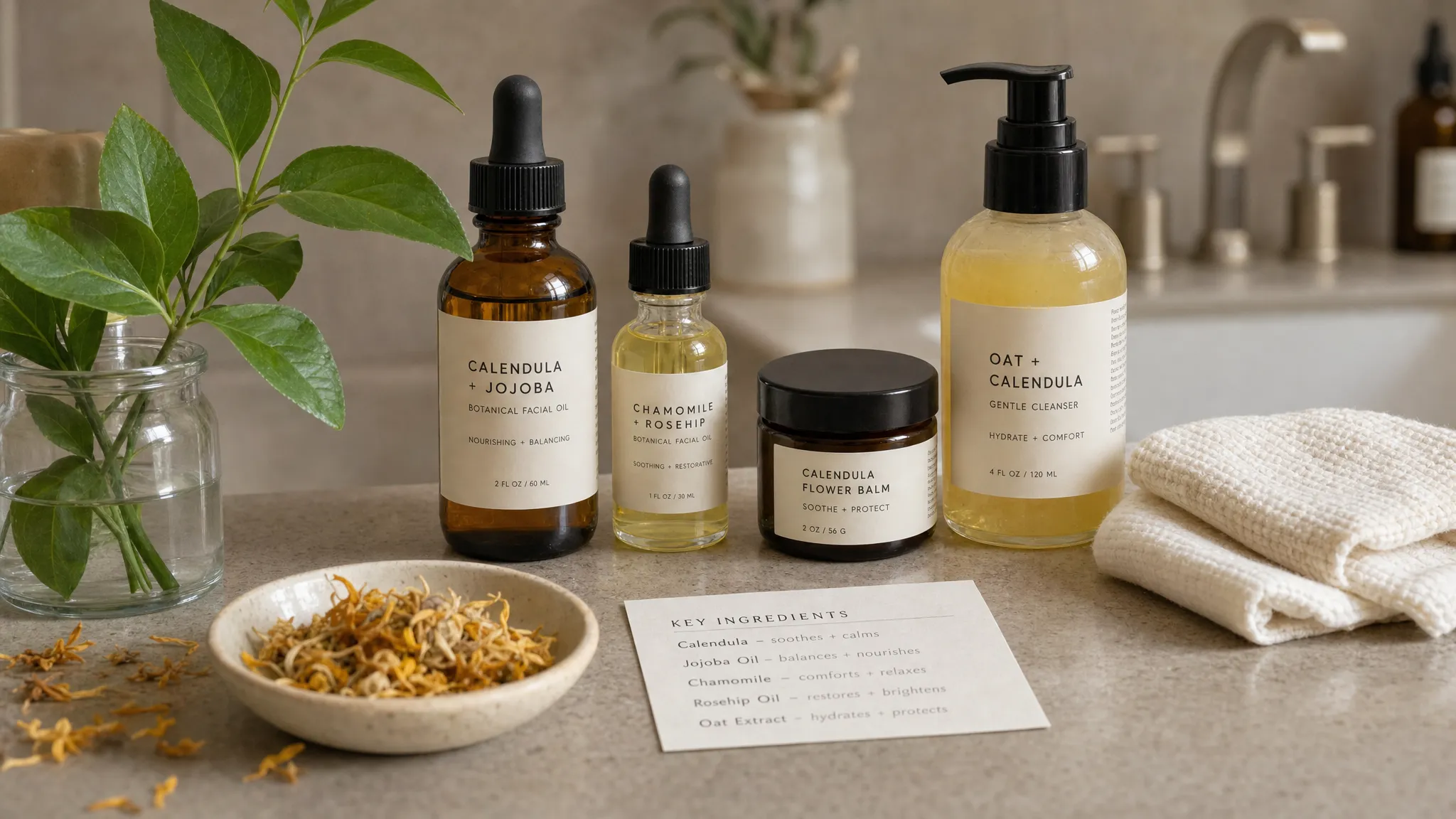
- Herbal infusions such as calendula or chamomile
- Naturally derived antioxidants such as vitamin E
- Essential oils only when used intentionally and at skin-appropriate levels
Be careful with vague terms. Fragrance or parfum can hide a complex scent blend, which may be fine for some people but irritating for sensitive skin. The same is true for very long ingredient lists that combine multiple essential oils, exfoliating acids, and active botanicals in one product. More is not always better.
Natural also does not mean non-irritating. Poison ivy is natural, and so are many allergens. Essential oils, citrus extracts, and fragrant botanicals can be beautiful in the right formula, but they deserve the same respect as any other active ingredient.
Evaluate the whole formula, not isolated ingredients
Ingredient quality matters, but formulation is what determines how a product behaves on skin. A single organic oil can be lovely, but a well-composed balm, cleanser, or body oil may deliver a better sensory experience and a more balanced result.
One of the most important questions is whether the product contains water. Water-based products, such as lotions, gels, creams, and hydrating mists, generally need a preservation system because water can support microbial growth. Oil-based products, such as facial oils, body oils, and many balms, are anhydrous, meaning they do not contain water. These formulas may be preservative-free when made and handled correctly, though they still need protection from oxidation, heat, light, and contamination.
Antioxidants such as vitamin E can help slow rancidity in oils, but they are not the same as broad-spectrum preservatives. This distinction is essential when choosing natural beauty products, especially if you prefer formulas with no synthetic preservatives.
| Product type | What to look for | Why it matters |
|---|---|---|
| Facial oil | Fresh plant oils, dark or protective packaging, clear usage guidance | Oils can oxidize when exposed to heat, light, and air |
| Balm | Butters, oils, waxes, clean handling instructions | Balms seal moisture and support the barrier, especially on dry areas |
| Oil cleanser | Rinse-away performance, gentle emulsifiers if included, non-stripping feel | Cleansing should remove buildup without leaving skin tight |
| Lotion or cream | Safe preservation system, stable texture, transparent ingredient list | Water-based products need microbial protection |
| Lip product | Food-adjacent simplicity, waxes or butters, no irritating flavor overload | Lips are delicate and easily sensitized |
Check certifications, but do not rely on them blindly
Certifications can be helpful, especially when you are comparing brands you do not know. The USDA organic labeling standards provide a framework for organic claims on eligible agricultural ingredients and products. Cruelty-free certifications, such as Leaping Bunny, can also make animal testing policies easier to verify.
Still, certifications are not the only sign of quality. Some small-batch or independent brands may use high-integrity ingredients without carrying every certification due to cost, scale, or the complexity of certifying multi-ingredient cosmetics. In those cases, transparency becomes even more important.
Ask practical questions:
- Does the brand publish complete ingredient lists?
- Does it explain what natural, organic, vegan, or cruelty-free means in its own standards?
- Does it identify which products contain beeswax or other animal-derived ingredients?
- Does it offer realistic guidance on use, storage, and shelf life?
- Does it avoid miracle claims and fear-based marketing?
A trustworthy brand should help you make an informed decision, not pressure you into buying through confusion.
Watch for greenwashing red flags
Greenwashing happens when a product looks more natural, organic, ethical, or sustainable than it really is. In beauty, this can be subtle. A package may be covered in leaves, use earthy colors, or highlight one botanical extract while the rest of the formula does not match the same philosophy.
Common red flags include vague claims like nature-inspired without meaningful detail, missing ingredient lists on product pages, heavy reliance on free-from claims without explaining what the formula actually contains, and exaggerated promises such as instant repair or permanent transformation.
Another red flag is chemical-free language. Everything is made of chemicals, including water, shea butter, and lavender oil. A more credible brand will explain which ingredients it avoids, why it avoids them, and what it uses instead.
Luxury can also be misleading. A high price, glass bottle, or elegant box does not guarantee better formulation. True luxury in natural organic beauty is thoughtful sourcing, skin comfort, freshness, restraint, and a product you enjoy using consistently.
Build a simple routine before expanding
The easiest way to choose better beauty products is to buy within a routine, not one impulse at a time. A minimal routine makes it easier to notice what works and what causes irritation.
For most people, a natural organic skincare routine can begin with three core steps: cleanse gently, nourish with oils or hydration, and seal or protect when needed. Body care can follow the same logic. Cleanse without stripping, apply oil to damp skin, and use balm on extra-dry areas.
If you are transitioning from conventional products, replace one category at a time. Start with the product that covers the most skin or stays on the longest, such as body oil, face oil, balm, or moisturizer. Then move to cleansers, lip care, and occasional treatments.
Patch testing is worth the extra day or two. Apply a small amount of the product to a discreet area, such as the inner arm or behind the ear, and watch for redness, itching, burning, or bumps. This is especially important for sensitive skin, babies, pregnancy, fragrance allergies, and any product with essential oils.
A practical checklist for choosing natural organic beauty products
Use this checklist when shopping online, in a boutique, or at a local apothecary.
- Define the job of the product: Decide whether you need cleansing, moisturizing, barrier support, glow, body care, lip care, or a calming ritual.
- Read the full ingredient list: Do not rely only on front-label claims, botanical imagery, or product names.
- Look for ingredient specificity: Prefer brands that name their oils, butters, waxes, extracts, and scent components clearly.
- Check organic context: Look for certification or a clear explanation of organic ingredient percentages and sourcing.
- Match texture to your skin: Choose lighter oils for facial use if you clog easily and richer balms for dry patches or body care.
- Review preservation and packaging: Water-based products need preservation, while oil-based products need protection from heat, light, air, and water contamination.
- Evaluate ethics honestly: If vegan or cruelty-free matters to you, verify the policy and check for animal-derived ingredients.
- Start slowly: Introduce one new product at a time so your skin can tell you what it likes.
This process may feel slower than grabbing the prettiest bottle, but it usually saves money, irritation, and clutter.
Frequently Asked Questions
What is the difference between natural and organic beauty products? Natural refers to ingredients that come from natural sources, while organic refers to how agricultural ingredients are grown and processed. A product can be natural but not organic, organic in part but not fully natural, or both, depending on the formula and certification.
Are natural organic beauty products better for sensitive skin? They can be, especially when formulas are simple, fragrance-conscious, and barrier-supportive. However, natural ingredients can still irritate sensitive skin. Patch testing and avoiding overly complex formulas are important.
How can I tell if a product is truly organic? Look for USDA organic certification when applicable, organic percentages, certified organic ingredients in the ingredient list, and transparent sourcing information. If the claim is vague, ask the brand for clarification.
Do natural beauty products need preservatives? Water-based products usually need a preservation system to stay safe. Waterless oils and balms may be preservative-free, but they still need careful packaging, clean use, and proper storage.
What should I switch first when moving to natural organic beauty products? Start with leave-on products that cover a large area, such as body oil, face oil, balm, or moisturizer. These have longer contact with your skin, so upgrading them can make your routine feel better quickly.
Choose fewer, better products you can trust
Choosing natural organic beauty products is not about perfection. It is about becoming a more thoughtful reader of labels, a better listener to your skin, and a more selective shopper.
If you want a simpler place to begin, explore Baby le Bébé, a curated natural apothecary offering 100% natural, 99% organic, cruelty-free skincare and body care with no synthetics and no parabens. From botanical oils to balms and cleansers, the goal is healthy, feel-good skin through ingredients you can understand and rituals you will actually keep.


0 comments